Most predictions about the skills we will need in the years ahead begin with AI, and the World Economic Forum agrees: its Future of Jobs Report 2025 places AI and big data at the top of the fastest-growing skills. But the same report also lists empathy and active listening among essential skills, and finds no substitution potential for AI in skills rooted in human interaction.1 That is the other half of the story worth paying attention to.
We have never had more ways to reach one another and, yet, genuine human connection is losing space. Across 21 European countries, the OECD found that daily face-to-face contact with friends and family declined consistently between 2006 and 2022.2 Social media promised to close that distance. Instead, it keeps us up to date on other people’s lives without making us more available to them. Often, it shows us edited lives rather than letting us take part in them. And that is no accident: Meta recently agreed to pay billions of dollars to settle U.S. cases alleging that it used addictive features to keep younger users on its platforms for longer, without admitting wrongdoing.3 In the attention economy, our time is the product.
A lot is at stake, because connection is not a luxury. The Harvard Study of Adult Development, which has followed participants since 1938, found that close relationships contribute more to a happy and healthy life than money or fame: the people most satisfied with their relationships at 50 were the healthiest at 80.4 And it does not take much. A University of Kansas study found that a single quality conversation with a friend in a day was enough to increase happiness and reduce stress by the end of the day.5
So why does this still escape us if it matters so much to our well-being and health? The problem is not a lack of willingness. It is visibility, coordination, and effort. Connection needs three things at once: time, energy, and willingness. Call it social availability. In increasingly busy and demanding lives, those three things rarely line up and, when they do, there is no easy way to share it. Research also shows that we underestimate how much other people enjoy hearing from us, so we hold back.6
Imagine two free hours on a long drive. Time for a call, energy for it, and the desire to spend it with someone close to you. But no simple way to know who is free, or to tell everyone at once that you are. So you put on a podcast. The drive is the same. The conversation never happens. This small moment repeats itself during commutes, lunch breaks, and quiet Sunday afternoons.
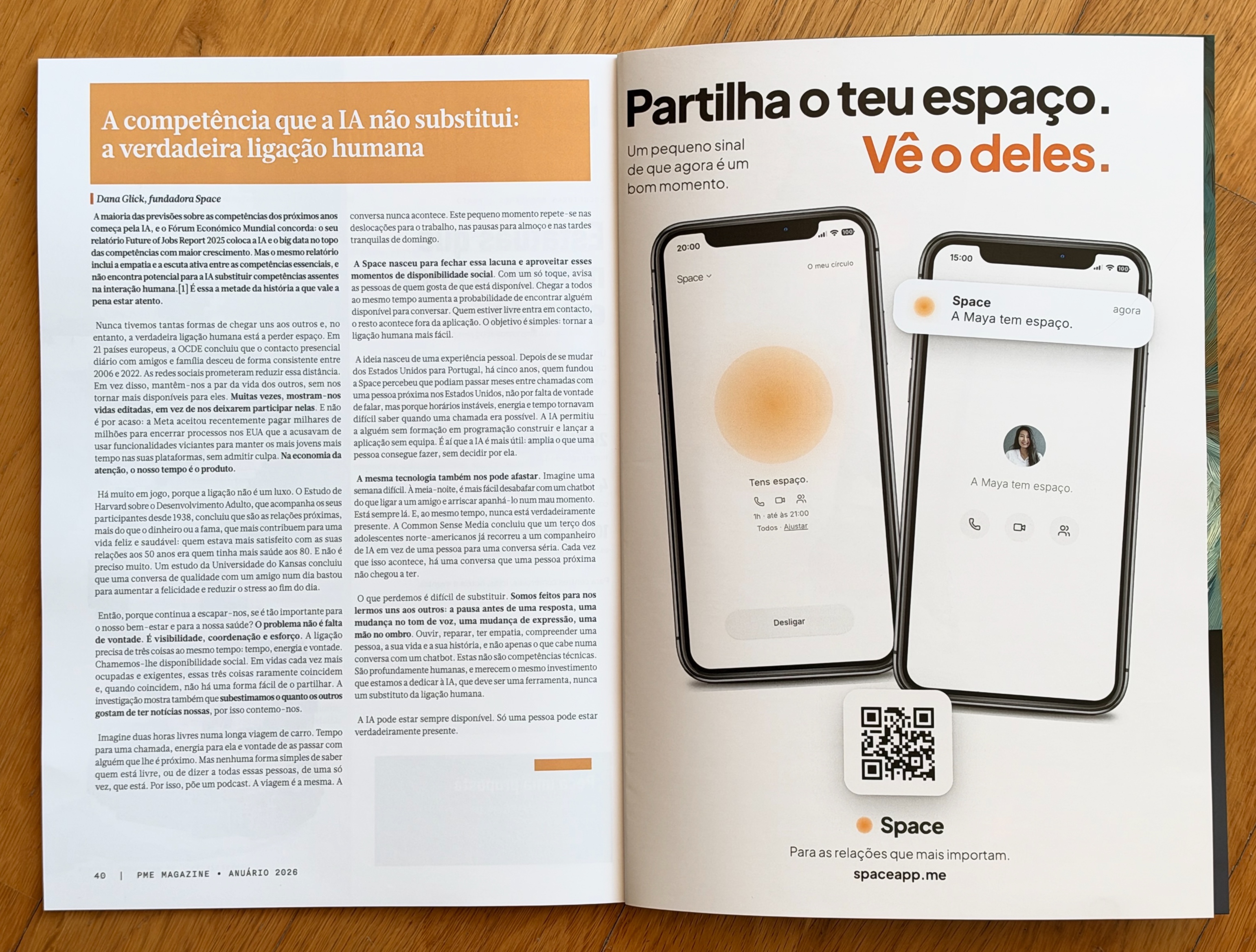
Space was created to close that gap and make better use of those moments of social availability. With a single tap, we let the people we care about know we’re available. Reaching everyone at once increases the chance of finding someone free to talk. Whoever is available gets in touch, the rest happens outside the app. The goal is simple: make human connection easier.
The idea came from personal experience. After moving from the United States to Portugal five years ago, Space’s founder realised that months could pass between calls with someone close in the U.S., not because they did not want to talk, but because unpredictable schedules, energy, and time made it difficult to know when a call was possible. AI allowed someone with no programming background to build and launch the app without a team. That is where AI is most useful: it expands what one person can do without deciding for them.
The same technology can also pull us apart. Imagine a difficult week. At midnight, it is easier to vent to a chatbot than to call a friend and risk catching them at a bad time. It is always there. And, at the same time, it is never truly present. Common Sense Media found that one third of U.S. teens had turned to an AI companion instead of a person for a serious conversation.7 Each time that happens, there is a conversation someone close to them never got to have.
What we lose is hard to replace. We are built to read one another: the pause before an answer, a shift in tone of voice, a change in expression, a hand on a shoulder. Listening, noticing, empathising, understanding a person, their life and their story, not just what fits into a conversation with a chatbot. These are not technical skills. They are deeply human, and they deserve the same investment we are putting into AI, which should be a tool, never a substitute for human connection.
Sources
- World Economic Forum, Future of Jobs Report 2025, skills outlook. Source ↗
- OECD, Social Connections and Loneliness in OECD Countries (2025), daily face-to-face contact in 21 European countries, 2006 to 2022. Source ↗
- Meta settlement with 29 US states, approved 26 August 2026, without admission of liability (Hunton). Source ↗
- Harvard Study of Adult Development (Harvard Gazette). Source ↗
- University of Kansas, one quality conversation a day (Communication Research, 2023). Source ↗
- Liu, Rim, Min and Min, “The Surprise of Reaching Out” (Journal of Personality and Social Psychology, 2022). Source ↗
- Common Sense Media, Talk, Trust, and Trade-Offs (July 2025). Source ↗
A maioria das previsões sobre as competências dos próximos anos começa pela IA, e o Fórum Económico Mundial concorda: o seu relatório Future of Jobs Report 2025 coloca a IA e o big data no topo das competências com maior crescimento. Mas o mesmo relatório inclui a empatia e a escuta ativa entre as competências essenciais, e não encontra potencial para a IA substituir competências assentes na interação humana.1 É essa a metade da história a que vale a pena estar atento.
Nunca tivemos tantas formas de chegar uns aos outros e, no entanto, a verdadeira ligação humana está a perder espaço. Em 21 países europeus, a OCDE concluiu que o contacto presencial diário com amigos e família desceu de forma consistente entre 2006 e 2022.2 As redes sociais prometeram reduzir essa distância. Em vez disso, mantêm-nos a par da vida dos outros, sem nos tornar mais disponíveis para eles. Muitas vezes, mostram-nos vidas editadas, em vez de nos deixarem participar nelas. E não é por acaso: a Meta aceitou recentemente pagar milhares de milhões para encerrar processos nos EUA que a acusavam de usar funcionalidades viciantes para manter os mais jovens mais tempo nas suas plataformas, sem admitir culpa.3 Na economia da atenção, o nosso tempo é o produto.
Há muito em jogo, porque a ligação não é um luxo. O Estudo de Harvard sobre o Desenvolvimento Adulto, que acompanha os seus participantes desde 1938, concluiu que são as relações próximas, mais do que o dinheiro ou a fama, que mais contribuem para uma vida feliz e saudável: quem estava mais satisfeito com as suas relações aos 50 anos era quem tinha mais saúde aos 80.4 E não é preciso muito. Um estudo da Universidade do Kansas concluiu que uma conversa de qualidade com um amigo num dia bastou para aumentar a felicidade e reduzir o stress ao fim do dia.5
Então, porque continua a escapar-nos, se é tão importante para o nosso bem-estar e para a nossa saúde? O problema não é falta de vontade. É visibilidade, coordenação e esforço. A ligação precisa de três coisas ao mesmo tempo: tempo, energia e vontade. Chamemos-lhe disponibilidade social. Em vidas cada vez mais ocupadas e exigentes, essas três coisas raramente coincidem e, quando coincidem, não há uma forma fácil de o partilhar. A investigação mostra também que subestimamos o quanto os outros gostam de ter notícias nossas, por isso contemo-nos.6
Imagine duas horas livres numa longa viagem de carro. Tempo para uma chamada, energia para ela e vontade de as passar com alguém que lhe é próximo. Mas nenhuma forma simples de saber quem está livre, ou de dizer a todas essas pessoas, de uma só vez, que está. Por isso, põe um podcast. A viagem é a mesma. A conversa nunca acontece. Este pequeno momento repete-se nas deslocações para o trabalho, nas pausas para almoço e nas tardes tranquilas de domingo.
A Space nasceu para fechar essa lacuna e aproveitar esses momentos de disponibilidade social. Com um só toque, avisa as pessoas de quem gosta de que está disponível. Chegar a todos ao mesmo tempo aumenta a probabilidade de encontrar alguém disponível para conversar. Quem estiver livre entra em contacto, o resto acontece fora da aplicação. O objetivo é simples: tornar a ligação humana mais fácil.
A ideia nasceu de uma experiência pessoal. Depois de se mudar dos Estados Unidos para Portugal, há cinco anos, quem fundou a Space percebeu que podiam passar meses entre chamadas com uma pessoa próxima nos Estados Unidos, não por falta de vontade de falar, mas porque horários instáveis, energia e tempo tornavam difícil saber quando uma chamada era possível. A IA permitiu a alguém sem formação em programação construir e lançar a aplicação sem equipa. É aí que a IA é mais útil: amplia o que uma pessoa consegue fazer, sem decidir por ela.
A mesma tecnologia também nos pode afastar. Imagine uma semana difícil. À meia-noite, é mais fácil desabafar com um chatbot do que ligar a um amigo e arriscar apanhá-lo num mau momento. Está sempre lá. E, ao mesmo tempo, nunca está verdadeiramente presente. A Common Sense Media concluiu que um terço dos adolescentes norte-americanos já recorreu a um companheiro de IA em vez de uma pessoa para uma conversa séria.7 Cada vez que isso acontece, há uma conversa que uma pessoa próxima não chegou a ter.
O que perdemos é difícil de substituir. Somos feitos para nos lermos uns aos outros: a pausa antes de uma resposta, uma mudança no tom de voz, uma mudança de expressão, uma mão no ombro. Ouvir, reparar, ter empatia, compreender uma pessoa, a sua vida e a sua história, e não apenas o que cabe numa conversa com um chatbot. Estas não são competências técnicas. São profundamente humanas, e merecem o mesmo investimento que estamos a dedicar à IA, que deve ser uma ferramenta, nunca um substituto da ligação humana.
Fontes
- Fórum Económico Mundial, Future of Jobs Report 2025, perspetiva de competências. Fonte ↗
- OCDE, Social Connections and Loneliness in OECD Countries (2025), contacto presencial diário em 21 países europeus, 2006 a 2022. Fonte ↗
- Acordo da Meta com 29 estados norte-americanos, aprovado a 26 de agosto de 2026, sem admissão de responsabilidade (Hunton). Fonte ↗
- Estudo de Harvard sobre o Desenvolvimento Adulto (Harvard Gazette). Fonte ↗
- Universidade do Kansas, uma conversa de qualidade por dia (Communication Research, 2023). Fonte ↗
- Liu, Rim, Min e Min, “The Surprise of Reaching Out” (Journal of Personality and Social Psychology, 2022). Fonte ↗
- Common Sense Media, Talk, Trust, and Trade-Offs (julho de 2025). Fonte ↗